
Email: sdraytan@163.com Tel: 0086-137-3096-1137
Email: sdraytan@163.com Tel: 0086-137-3096-1137
In the overseas medical device procurement market, traditional trolley‑mounted ultrasound devices are seeing stagnant market growth due to constraints of premises, budgets and usage scenarios. By contrast, portable/mobile ultrasound devices have emerged as a fast‑growing export star in recent years, boasting core strengths of flexible adaptability, high cost‑efficiency and strong versatility across scenarios.
Demand for mobile ultrasound devices has surged especially in overseas community primary‑care clinics, rural medical posts, pre‑hospital emergency care, emergency medical programs and mobile free‑clinic initiatives. They are also key procurement items for overseas agents, government medical‑aid projects and NGO emergency‑relief programs.
Many foreign‑trade practitioners know these devices sell well yet lack clarity on clients’ real procurement preferences, core rigid requirements and selection criteria. This article offers an in‑depth analysis of the overseas strengths, major application scenarios and purchasing logic of mobile ultrasound devices, to help you respond to inquiries precisely and secure orders efficiently.
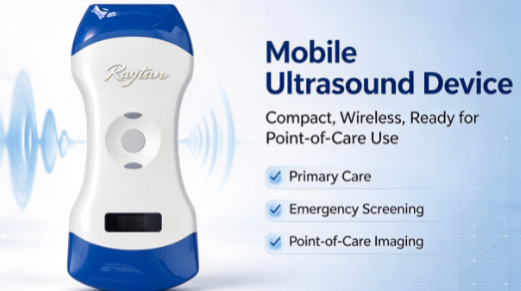
The global portable ultrasound device market maintains robust and steady growth. Different from niche‑demanded high‑end large‑scale imaging equipment, mobile ultrasound caters to the global trend of decentralized healthcare, covering two major growth drivers: renewal of primary‑care facilities in Europe and North America, and infrastructure expansion in emerging markets.
Statistics show that over 85% of primary‑care institutions in Europe and North America are now equipped with at least one mobile ultrasound device, with rising penetration in pre‑hospital emergency settings. In Southeast Asia, Latin America, the Middle East, Africa and other regions, portable ultrasound serves as core equipment for rural healthcare popularization and emergency‑rescue system development, generating steady bulk government‑procurement orders and public‑welfare aid‑project contracts.
Far less bulky, costly and installation‑dependent than trolley‑mounted ultrasound systems, mobile ultrasound perfectly addresses the pain points of scattered primary‑care resources, limited premises, constrained budgets and mobility‑driven emergency operations overseas, making it an optimal solution for the global decentralized healthcare market.

Numerous overseas community clinics and rural medical posts occupy small premises with no dedicated imaging examination rooms, leaving no room for conventional trolley‑mounted ultrasound units. Mobile ultrasound devices are lightweight, compact for easy storage and require no fixed installation — ready for use right out of the box.
Medical staff may carry them around or move them between consultation rooms. They are also ideal for special use cases such as mobile medical vehicles, outreach free clinics, home visits and field rescue — an irreplaceable merit of mobile ultrasound and the top consideration for primary‑care clinic buyers.
In pre‑hospital emergencies, traffic‑crash trauma and emergency resuscitation, diagnosis speed directly impacts patient outcomes. Mobile ultrasound boots up rapidly and delivers instant imaging with minimal complex adjustments, enabling quick screening of critical sites including the thoracic cavity, abdominal cavity, heart and blood vessels.
Clinical data indicates that point‑of‑care mobile ultrasound can boost diagnostic efficiency for acute conditions such as trauma, pneumothorax and pericardial effusion by 30%‑40%. It enables emergency responders to rapidly assess patient status and define treatment plans, greatly lowering risks of misdiagnosis and delayed intervention, and fully satisfying stringent clinical requirements of overseas emergency‑response programs.
Remote areas and primary‑care clinics worldwide commonly face shortages of specialized radiologists. Conventional trolley‑mounted ultrasound systems involve steep learning curves that front‑line grassroots medical workers struggle to master.
Modern mobile ultrasound devices feature streamlined smart user interfaces with pre‑configured parameters for multiple clinical scenarios. General practitioners and emergency personnel can operate them proficiently after brief training, without formal radiology qualifications. This drastically lowers adoption barriers for grassroots healthcare and underpins its widespread roll‑out across national primary‑care systems.
High‑end trolley‑mounted ultrasound carries high unit prices and maintenance costs, making it unsuitable for large‑scale roll‑out at the primary‑care level. Mobile ultrasound devices offer affordable pricing and excellent cost‑performance, alongside low failure rates, simple maintenance and universal spare parts. They substantially cut procurement and long‑term operating costs for medical institutions.
Whether for individual purchases by private primary‑care clinics or bulk tenders under government universal‑health programs and overseas aid initiatives, they deliver compelling price competitiveness, lower deal‑closing thresholds and broader market reach.
Core requirements: general‑purpose clinical coverage, user‑friendly operation, compact footprint, high cost‑efficiency
Overseas community clinics deliver comprehensive general‑practice services covering routine screenings for abdomen, obstetrics‑gynecology, urology, small organs and more. Ultra‑high‑end specialized features are unnecessary. Buyers prioritize device stability, image clarity and battery life. They tend to select wireless portable models supporting offline data storage for routine physical examinations, rejecting over‑featured, over‑priced units.
Core requirements: ultra‑fast boot‑up, stable imaging, rugged build, adaptability to harsh environments
Use cases including ambulances, field rescue, mobile emergency medical teams and field‑hospital settings impose far stricter equipment demands. Buyers favor shock‑ and drop‑resistant models with long‑lasting battery performance and wide operating‑temperature tolerance. They require support for rapid bedside FAST trauma assessment and real‑time patient monitoring. Wireless image transmission and cloud‑based data synchronization are also valued to facilitate remote expert consultations.
Driven by new‑build healthcare infrastructure and rural‑health outreach, procurement priorities are complete compliance certification, intuitive operation, rugged durability and accessible after‑sales support. Clients prefer models holding full CE and ISO certifications, compatible with local voltage standards, and equipped with English‑language operating systems and documentation for smooth customs clearance and immediate clinical deployment.
Prioritize scenario‑specific matching instead of blindly recommending high‑end configurations For primary‑care clinics and routine screening, high‑end 4D color ultrasound units are unnecessary; standard high‑definition portable color ultrasound models suffice. Overspecified hardware inflates client budgets and reduces deal probability. For emergency projects, recommend upgraded ruggedized variants featuring fast boot‑up and multi‑functional screening capabilities.
Compliance and local adaptability are non‑negotiable prerequisites for exports Export‑bound medical devices must hold complete export certifications. System language, voltage, power connectors, user manuals and certification reports must fully align with target‑market requirements to prevent customs‑clearance failures or inoperable hardware.
Strong after‑sales service serves as a key competitive differentiator Overseas buyers attach great importance to after‑sales guarantees. Prefer mature, mechanically stable, low‑failure‑rate models. Offer remote technical troubleshooting, English‑language technical support and fast spare‑parts supply to build trust with partners and customers.
Driven by global decentralized healthcare, primary‑care expansion and improved emergency‑rescue infrastructure, overseas market demand for portable mobile ultrasound devices will keep growing. They represent a sustainable high‑demand product category for medical‑device foreign‑trade enterprises. Only by accurately addressing purchasing preferences across different scenarios and geographies, selecting suitable equipment and offering targeted quotations can businesses capture new‑market opportunities and boost order‑conversion rates.
Our company supplies a full portfolio of black‑and‑white / color mobile ultrasound systems and palm‑sized portable ultrasound scanners. Our product line covers primary‑care clinics, pre‑hospital emergency response, mobile free‑clinic services, overseas medical‑aid projects and more. With complete certifications and reliable quality, we support bulk export and OEM customization, alongside full sets of English‑language documentation and professional foreign‑trade support.
Medical‑device distributors, healthcare procurement organizations and project contractors worldwide are welcome to reach out for detailed specifications and bulk quotation proposals.

Contact: Raytan
Phone: 0086-13730961137
Tel: 0086-137-3096-1137
Email: sdraytan@163.com
Add: Langya Port Road, Hi-Tech Development Zone, Qingdao, Shandong Province
We chat
