
Email: sdraytan@163.com Tel: 0086-137-3096-1137
Email: sdraytan@163.com Tel: 0086-137-3096-1137
The core principle of emergency medicine lies in the golden time window: patients who receive proper assessment and intervention within the first 30 minutes after an ambulance is dispatched show significantly improved survival rates. This requires emergency teams to complete critical diagnostics during patient transport, instead of waiting until arrival at hospital facilities.
Three driving forces are pushing emergency‑care devices toward portability:
Development of pre‑hospital emergency systems: Governments worldwide are increasing investment in emergency centers and ambulance configurations, upgrading ambulances from mere transport vehicles into mobile resuscitation units.
Disaster and public‑health emergencies: Humanitarian‑relief missions responding to earthquakes, floods and conflicts sustain strong demand for portable diagnostic equipment.
Remote‑medical collaboration: Mobile devices collect patient data and transmit it back to hospitals in real time, enabling emergency departments to prepare for incoming admissions in advance.
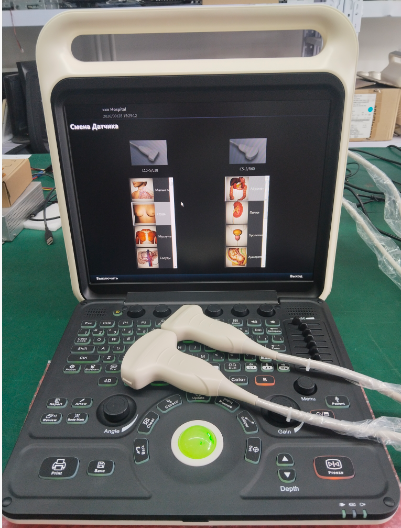
Ultrasound represents one of the most valuable imaging modalities for emergency settings: radiation‑free, real‑time and repeatable. Emergency ultrasound protocols (e.g., FAST trauma assessment, pulmonary‑fluid evaluation and cardiac‑function assessment) have become standard competencies for emergency physicians.
Emergency‑scenario clinical applications
| Emergency Application | Clinical Value |
|---|---|
| Trauma FAST Scan | Rapid detection of intra‑thoracic and intra‑abdominal hemorrhage to guide decisions for direct surgical referral |
| Pneumothorax / Pleural Effusion | Bed‑side identification within 30 seconds, faster and more effective than chest radiography |
| Obstetric Emergencies | Quick evaluation of fetal heart rate, fetal position and hemorrhage caused by ectopic pregnancy |
| Cardiac‑function Assessment | Detect cardiac tamponade and cardiac output to guide fluid‑resuscitation therapy |
Key Selection Criteria for Emergency Use
Preference for hand‑held ultrasound: Space inside ambulances is limited, making integrated‑probe devices highly desirable.
Instant‑on scanning: Emergency response cannot wait for device warm‑up; imaging output must be available within 5 seconds.
Shock and vibration resistance: Stable imaging performance even while the ambulance is in motion.
One‑touch presets: Pre‑configured settings for adults, paediatric patients, trauma and obstetric cases so emergency clinicians avoid manual parameter adjustment on‑site.
Unlike ward‑based monitors, transport monitors must deliver stable continuous vital‑sign monitoring during movement while remaining lightweight, shock‑resistant and long‑lasting on battery power.
Emergency‑scenario requirements
Pre‑hospital ambulance care: Continuous monitoring of ECG, SpO₂ and NIBP from scene of incident to hospital, with immediate alerts for abnormal readings.
Intra‑hospital critical‑patient transfer: Uninterrupted monitoring during ICU‑to‑operating‑room and operating‑room‑to‑ICU transfers.
Field‑medical evacuation: Graded transport of battlefield casualties from forward outposts to rear‑echelon medical facilities.
Key Selection Criteria for Emergency Use
Battery runtime ≥ 4 hours: Sufficient for a complete transport mission, with support for vehicle‑mounted charging.
Shock‑proof and dust‑proof: Higher protection ratings than ward‑grade equipment to preserve measurement accuracy under ambulance vibration.
Rapid installation: Mountable on stretcher rails or ambulance brackets and fully operational within 2 minutes.
High‑volume alarm output: Audible alerts remain intelligible in the noisy ambulance environment.
Complete core parameters: ECG, SpO₂, NIBP and temperature as standard; premium models add EtCO₂ (end‑tidal carbon dioxide).
Conventional X‑ray systems require dedicated shielded rooms and are impractical for emergency contexts. Portable X‑ray units (including mobile DR and hand‑held X‑ray devices) remove such constraints and deliver prominent value for emergency and field‑medical workflows.
Emergency‑scenario applications
Bed‑side emergency radiography: Imaging for critically immobile patients to evaluate pulmonary oedema, pneumothorax and endotracheal‑tube placement.
Field / field‑hospital workflows: Rapid identification of fractures and penetrating thoraco‑abdominal injuries under field conditions.
Disaster‑relief operations: Quick triage of casualties rescued from collapsed structures.
Community / nursing‑home outreach: On‑site radiography for mobility‑impaired elderly patients.
Key Selection Criteria for Emergency Use
Lightweight build: Mobile DR units ideally under 50 kg, with wheeled mobility and modular disassembly. Hand‑held X‑ray devices are lighter yet subject to power‑output limitations.
Wireless flat‑panel detector: Cable‑free deployment ready for immediate use inside ambulances.
Battery‑driven operation: Independence from mains power, an essential feature for field‑relief missions.
Fast deployment: First diagnostic image available within 5 minutes of unpacking — speed is critical in emergencies.
Radiation safety: Portable X‑ray machines deliver lower doses than fixed DR systems; lead aprons and thyroid collars are still required for on‑site emergency operators.
| Region | Project Profile | Frequently‑procured Equipment |
|---|---|---|
| Middle East | Large‑scale emergency‑system upgrades; government‑led tenders with substantial budgets | Transport monitors, portable ultrasound, defibrillators / AED, mobile DR |
| Southeast Asia | Expansion of private hospitals and emergency centres; bulk procurement of ambulance‑fitted equipment | Portable ultrasound, transport monitors, portable X‑ray machines |
| Africa | Humanitarian‑aid procurement by organisations including UNOPS and WHO | Hand‑held ultrasound, basic transport monitors, lightweight X‑ray units |
| Latin America | Public‑emergency‑system renewal, concentrated projects in Brazil and Mexico | Transport monitors, portable colour ultrasound, defibrillator‑monitors |
Emergency‑care buyers rarely purchase single units; they require complete emergency‑unit configurations combining transport monitors, portable ultrasound, defibrillators and emergency consumables. Suppliers delivering integrated ambulance‑solution packages gain stronger competitiveness than vendors selling standalone devices.
Emergency‑project equipment faces harsher operating conditions than clinic‑grade gear: shock resistance, dust‑proofing, water resistance, wide operating‑temperature ranges and long battery life. Highlight these specifications prominently in product brochures to catch the attention of procurement stakeholders.
Bodies such as UNOPS, the Global Fund and the International Committee of the Red Cross maintain long‑term Long‑Term Agreements (LTA). Chinese manufacturers that qualify for their supplier rosters secure stable, recurring order volumes. Prepare relevant certifications and product qualifications well in advance.
Emergency responders are often not specialist radiologists or sonographers and need concise operational training. Emergency‑oriented quick‑reference guides and pre‑configured examination protocols accelerate user adoption and support repeat purchases.
Mobile and portable emergency‑medical equipment represents one of the most definite growth markets over the next five years. From ambulances and field medical cabins to disaster relief and community‑level emergency response, portable ultrasound, transport monitors and portable X‑ray machines are evolving into standard components of global emergency‑medical infrastructure.
Raytan supplies a full portfolio of portable emergency‑medical devices including hand‑held ultrasound, transport monitors, mobile DR systems and defibrillators. We deliver complete emergency‑unit configuration solutions with CE and other export certifications, and support bidding for international‑organisation tenders as well as procurement projects for national emergency centres. Overseas medical‑device distributors and emergency‑project contractors are welcome to reach out for business communication.

Contact: Raytan
Phone: 0086-13730961137
Tel: 0086-137-3096-1137
Email: sdraytan@163.com
Add: Langya Port Road, Hi-Tech Development Zone, Qingdao, Shandong Province
We chat
